


Towns are born, and towns die. Behind the Great Dividing Range, towns are on life support. In once-prosperous farming towns, six hours between Melbourne and Sydney, the pubs are shut, and weatherboard homes are boarded up.
The rain has come, turning pastures into fields of green. But resentment runs deep: over illegal clearing prosecutions, net zero, fuel prices, stagnating local economies, and a city-country divide that is fuelling distrust about decisions being made in the capitals.
Fewer jobs mean fewer people. Now there aren’t enough of them to staff critical services in regional areas across NSW and Victoria.

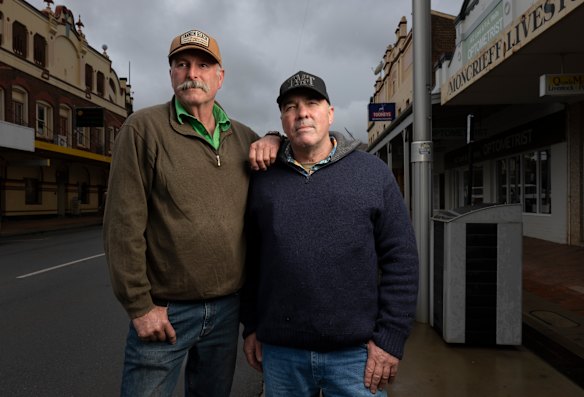
“If you bring the people out, then services come as well, but they can’t come out because there are no bloody services,” says Keith Rowe, a farmer in West Wyalong, a six-hour drive from Sydney and Melbourne.
“We really need more new people coming into our town. And we don’t care how that mix is made up.”
No political party has been able to break the economic cycle of decline in parts of regional Australia. Fewer people means schools and shops close. Children leave. In 1960, the median age in West Wyalong was 26. Now it’s 43. In nearby Grenfell, it’s 52. The impact compounds as the years roll on, then steams home when those left behind realise all they once knew might one day be gone.
“I think about it a lot,” says Rowe. “It’s a real serious dilemma we’ve got.”
Rowe’s friend, farmer Rod Hardie, issues this warning: “The current system, the current economy, the current way things are running – we won’t be here.”
Once upon a time the Nationals were the natural representatives of the vast tracts of land spanning Nicholls and Mallee in Victoria and the Riverina and Parkes in NSW. One Nation’s victory in the Farrer by-election in May and its surging support in national polls mean that all four are now in play.
In One Nation’s regional policy mix, immigration falls behind water buybacks and anti-net zero. Nevertheless, on a national scale, the party has harnessed the emotional impact of the perceived threat of immigration to its image of Australia, regardless of whether the large cuts it is proposing might do more harm than good to the economies it wants to represent.

Betty Wu has owned the last Chinese restaurant in West Wyalong for three decades. Now she is voting for One Nation.
“I’m voting for the lady,” she says, referring to One Nation leader Pauline Hanson, who once claimed Australia was being “swamped by Asians” like Wu. “Something needs to change.”
Wu, who migrated to Australia from Guangdong in South China, once had multiple competitors along West Wyalong’s main drag. Nearby restaurant Lam and May has gone takeaway only. At lunchtime on a Thursday, Wu sits alone in a banquet room, hoping someone will walk in.
“It’s hard,” she says. “There are no people. It’s so quiet.”
Nearby, in the regional hub of Cowra, once a postwar centre for Eastern European migrants, the shift from farmhands to an increasingly mechanised workforce has reduced the working-age population, while its retirement-age population has surged.
“I suppose we are the old WASPS, the white Anglo-Saxon Protestants and Catholics; that’s virtually what the town is these days, and that’s probably why we’re so conservative,” says mayor Paul Smith.
More than 75 per cent of Cowra’s 12,000 residents have parents who were both born in Australia; those who weren’t were mostly born in England, Scotland or New Zealand. A quarter of the town is aged 65 or over.
Meeting the needs of that population has become more challenging.
“I go to mayors’ conferences, and they’ve all got the same problem,” says Smith. “We have a brand-new hospital, which is more attractive to young graduates. The thing is, to get a doctor here, you have to have work for their partner. Now, if they’re another doctor, there’s no trouble. But if they are an engineer … that can make it difficult.”
This is the paradox facing One Nation. Newly elected One Nation Farrer MP David Farley is grappling with an electorate bordering the Riverina that already lacks enough workers to pick fruit, let alone staff hospitals. Now his party wants to cut immigration by 750,000 temporary migrants, and put Australia into three years of population decline before stabilising at 130,000 a year, 100,000 fewer than the government’s target.
It remains unclear if that 130,000 figure will exclude backpackers, nurses, Pacific Australia Labour Mobility workers and other skilled workers needed in the regions, as Farley suggested last month. His leader, Pauline Hanson, did not respond to requests for an interview.

The story across the country is not uniform. Shepparton is two hours’ drive north of Melbourne. It sits within the federal electorate of Nicholls, bordering Farley’s seat of Farrer.
Hanson has a foothold here too. Shepparton’s placid CBD is home to the office of Victoria’s only state One Nation MP, upper house member Rikkie-Lee Tyrrell.
Polling suggests Tyrrell could be joined by up to 11 more One Nation MPs after November’s state election. Some union-commissioned research has suggested the party could win up to 30 seats.
One Nation’s vote has jumped on the back of its anti-immigration message, Resolve Political Monitor polling shows, but a lot of that support is driven by anger that has nowhere else to go. It’s a lot easier to blame migrants than it is to blame the faceless forces of inflation and globalisation.
“It’s a story as old as time, where people feel insecure and when purse strings are tight,” says Professor Alan Gamlen, the director of the migration hub at the Australian National University.
“The world is changing too fast for people to comprehend, and they need a simple explanation. And it’s always been the case that blaming the outsiders, the witches, the infidels or the plague of locusts has been a really successful political strategy.”

Shepparton’s One Nation voting may be surging, but it has avoided the economic fate of West Wyalong and Cowra through waves of immigration that continue to this day.
Sunny Uppal’s family moved to Shepparton from India, via New Zealand, in 2003. “We always wanted to do farming because it’s in the blood,” the 41-year-old says.
For generations, Uppal’s family grew potatoes and wheat in Punjab. In Shepparton, they started with 30 acres of apple orchard and today have almost 200.
“I love seeing something grow out of the dirt,” he says. “The trees start to flower, the seasons change. A year goes by pretty fast here.”
Uppal estimates around 30 Indian families own farms around the Shepparton area.
They follow in the footsteps of Greeks, Italians and Albanians who came in the 1920s, then Turks in the 1960s.
Punjabis started arriving in the 1980s. In the 2021 Census, 1549 people living in Shepparton reported speaking Punjabi at home, the most common language after English, and representing 2.3 per cent of the population.
Uppal manages his orchards with his two brothers. In their large sorting shed, 30 workers are packing pears and apples into wooden crates for distribution around the country.

All are from overseas; some have migrated to Australia permanently. Others are on working holiday visas, fulfilling their 88 days of mandatory regional work – a critical supply of labour for one of the country’s largest fruit-growing regions.
Between 2000 and 3000 workers from the Pacific Islands also travel to the Shepparton area every year to work through the PALM scheme too.
“We don’t have enough working people here, that’s why we’re getting people from overseas,” says Uppal.
“Imagine if we don’t have them, we won’t have fruit for anybody. We need truck drivers, we need forklift drivers, fruit pickers, fruit packers. There’s so much that goes on there, and without them, we won’t be here.”
Shepparton has a constant demand for migrants to support its manufacturing industry, which includes fruit canneries and dairy processors, and essential services for the town of just over 65,076 people.
Over the past five years, the Committee for Shepparton has run a program helping 850 professionals move to Shepparton – the vast majority of them migrants – and links them with local sporting or social clubs.
The goal is not just a warm welcome; it’s to encourage workers to put down roots and stay put.
“It’s an essential contributor to the success of our economy,” says its CEO Linda Nieuwenhuizen.
Goulburn Valley Health, the only public hospital and main health service in the area, was struggling with a 20 per cent staff vacancy rate in 2023 but has brought that down to 8 per cent, mostly through international recruitment.
The anaesthetics team consists entirely of migrants. Ma Lenie Estrella, a nurse originally from the Philippines, worked in the United Arab Emirates for a decade before moving to Melbourne in 2023 and Shepparton in 2024, and has a working visa sponsored by GV Health.

“At first it was a culture shock. The main thing is communication. Sometimes Australians try to shorten things – like telly, bikkies, cuppa – so I’m not used to that,” she says. “But over time it gets better.”
A walk down Acacia Street punctures another tenet of Hansonism: the myth of Australia’s monocultural past.
Albanian Muslims started moving to Shepparton in the mid-1920s to work on the orchards and have been part of the town’s DNA ever since.
In 1956, the Albanian community started constructing Victoria’s first purpose-built mosque here. When it opened four years later, it was surrounded by fields furrowed for tomato plants; today, the cream-brick building sits in a pocket of tidy suburbia.
Enver Sabri and Riddy Ahmet were born in Shepparton to Albanian parents. They could barely speak English when they started school – but that wasn’t unusual in the 1950s and 1960s, when classrooms were a melting pot of Anglo, Greek, Turk, Italian and First Nations kids.
“If you talked English inside the house, you’d get your ears chopped off,” recalls Ahmet. His father would say: “When you come inside, you’ve got to speak Albanian because we might go back.”
The first wave of Albanians thought their time in Australia would be temporary, part of a long-standing cultural practice called kurbet, where a man would travel abroad for a few years before returning home. World War II and the communist takeover of Albania made returning too dangerous.
So they stayed, holding on to their Albanian culture and adapting to their new environment. Ahmet and Sabri worked the orchards, attended mosque, and on weekends performed in their country and western band.
Shane Sali is the second Albanian-Australian to serve as Greater Shepparton City Council’s mayor. He stood down in September, ahead of running as a National Party candidate in November’s state election.
“Shepparton is an excellent example of what strong multiculturalism looks like,” Sali says. “Our region’s history demonstrates the enormous value that migration can bring to the economy, workforce and community life.”

One hour south of Cowra, Young is another town that is anathema to the picture of Australia pushed by One Nation.
Between its rolling hills and cherry farms, a minaret is being lifted onto the newly renovated mosque on the town’s outskirts.
“It’s going to be the biggest building in town,” says a beaming Abdul Ghoneim, a member of the mosque’s committee and one of the organising forces behind the renovation.
The mosque, initially opened in the early 1990s by Lebanese immigrants, had become too small to accommodate the surging Muslim population in town, and has been renovated to expand the praying space and improve its facilities.
Ghoneim says the mosque has acted as an anchor for the steady stream of Lebanese and Muslim families leaving Sydney for Young.
Slowly but surely, their internal migration has reshaped the town into a unique regional migrant hub, complete with Lebanese bakeries and ethnic grocers.

Since 2006, the number of residents who were born overseas and with parents born overseas has doubled in Young, supercharging the demographic shift.
And it isn’t just Lebanese or Muslim communities, with increasing rates of residents speaking languages such as Chinese, Hazaragi, and Dari.
That steady stream has also meant Young has avoided the stagnation that has plagued surrounding towns, with population growing by over 8 per cent since 2001.
This demographic shift has had an obvious impact on the town’s economy, with steady growth in agricultural output, household salaries and rates of employment.
The town hums in the way a western Sydney suburb might, only with a regional tint. Muslim women in hijabs wander about with their children, greeting other townsfolk, while young people mill about outside the local manoush shop (the only such bakery for hundreds of kilometres).
Next door, at Maz Mart, an ethnic grocer that specialises in Arab goods including tinned chickpeas, Lebanese bread and tobacco for shisha, both Anglo and Arab locals shop.
“The non-Muslims shop here almost as much as the Muslims,” Abdullah AlShammari says as he helps a customer. “They buy everything, tomatoes, rice, even the sweets. They are our siblings, and we love it.”
“We are a Muslim community, but we are a part of Young, and we are proud of that,” Abdullah Sultan, one of the members of the Young Mosque committee, said at the opening ceremony.

Brian Ingram, the mayor of the local council, Hilltops Council, was also at the opening ceremony. He smiled broadly throughout the event. He said the steady flow of immigrant and Muslims families into Young has been nothing but a positive, fuelling economic growth and a vibrant cultural shift.
“They buy homes here, they pay rates here, they buy stores and supplies here, and that’s what it’s all about. And on top of that, they have some developers amongst them that are creating the opportunity for more housing, which is essential,” he said.
“Growth is good,” he added.
Young and Shepparton have positive stories. The challenge for Labor is selling them.

As immigration minister for more than a decade, Philip Ruddock travelled around the country holding town halls in cities and regional communities.
“Too often the debate is also shaped by prejudice, fear and, at times, blatant racism,” he says.
Ruddock says it’s time for Home Affairs Minister Tony Burke to do the same and visit cities and regional areas.
“One of the frustrations of national immigration policy is that national averages can conceal local realities. Sydney and Melbourne may experience congestion and pressure on services, while smaller states and regional communities are desperate for people,” he says.
“Every government faces the same temptation: to simplify the issue, to speak only to one side of the argument, to pretend that generosity requires no limits or that control requires no humanity. Neither position can sustain a nation-building immigration program.”
Ruddock, the longest-serving MP since Billy Hughes, says Australia faces a demographic truth that cannot be ignored.
“Advanced economies are ageing, with falling rates of fertility, and working-age populations shrinking or growing more slowly,” he said.
“That is why I found so much of the public debate frustrating. Critics often speak as though multiculturalism were a policy for migrants. I see it as a policy for Australia.”
Cut through the noise of federal politics with news, views and expert analysis. Subscribers can sign up to our weekly Inside Politics newsletter.

Leave a Reply